


In modern life, pathological changes affecting the skeletal and muscular system occur more and more often.One of the most common such diseases has become osteoarthritis of the knee joint, so the symptoms and treatment of such a disease should be known to everyone.This is a serious condition that causes significant deformation of the cartilage as it progresses.
According to statistics, the pathology usually affects people whose joints are constantly under excessive stress.Osteoarthritis and arthritis of the knee joint is predominantly a disease of older people, but deformation of cartilage can also occur at a younger age.In such cases, people turn to a wide variety of therapy methods.For example, some buy knee pads against osteoarthritis of the knee joint, but they are not always able to have an effect on the body.
%20and%20one%20affected%20by%20osteoarthritis%20(left).jpg)
Women, as well as people over 40, are most susceptible to osteoarthritis of the knee joint.
Causes of the disease
Osteoarthritis of the knee joint according to ICD10 is labeled as gonarthrosis, which is assigned the international classification code M17.The development of the disease is influenced by the human physiology itself.The knee is the largest joint in the body.The femur, fibula and tibia are connected here.The resulting structure acts as a hinge that allows the lower leg to perform flexion, extension, circular and rotational movements.
Since the knee is subjected to such a large amount of stress, pathological processes invariably begin to occur in the tissues with age.This is usually due to an unavoidable collagen deficiency, against the background of which cartilage tissue loses its elasticity.Also, over time, the body reduces the synthesis of synovial fluid, which normally lubricates the joints and prevents them from rubbing against each other.
Even simple walking over time, under the influence of the above factors, leads to the deformation of cartilage and the development of an inflammatory process.A number of reasons can provoke pathology at a younger age.Among them:
- Meniscus injuries, ligament sprains and other injuries;
- Heavy load on the legs as a result of sports training or prolonged standing;
- Surgical intervention in the knee area, especially to remove the meniscus;
- Excess weight, especially if it causes varicose veins;
- Local inflammatory processes, such as arthritis in the knee joint;
- Metabolism problems;
- Connective tissue dysplasia.
Some people are predisposed from birth to pathologies in the musculoskeletal system due to heredity.It is also believed that the disease can be triggered by fatigue and chronic stress.When deciding how to treat osteoarthritis of the knee joint, the doctor is aware of the causes of the disease.For positive dynamics, it is necessary not only to use special medications and a set of exercises, but also to influence the factor that caused the disease.
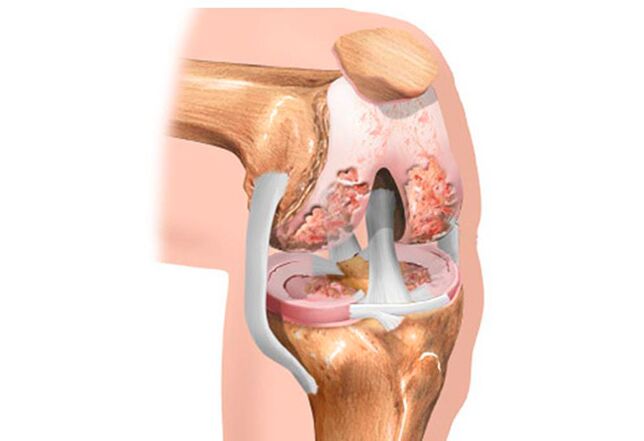
The development of the disease depends on a combination of negative factors, which worsen with age and can ultimately lead to the destruction of the knee cartilage.
Stages of pathology
It is usual to distinguish 3 degrees of the knee joint as it is affected by osteoarthritis.Initially, any problems can only really be noticed if an X-ray is performed.Osteoarthritis of the knee joint of the 1st degree has no signs that a person can detect on his own.Sometimes patients complain of pain when walking and a feeling of fatigue, but these symptoms are very mild and disappear after some rest.
Since few people decide to diagnose and treat the disease in the early stages, grade 2 osteoarthritis of the knee joint develops quickly.Despite the actual presence of the inflammatory process, it is sterile in nature and then progresses very slowly.Osteoarthritis of the 1st degree can reach the second in several months or years.When this happens, the situation will be characterized by the following manifestations:
- When bending the leg, a dull crunch is heard, which is accompanied by pain.The sound is associated with a severe lack of hyaluronic acid.
- If you walk for a long time, severe pain occurs in the joints.Even simple movements cause a feeling of heaviness and burning inside the knees.
- Limb mobility is limited;they can no longer work with the same amplitude.Some patients with grade 2 osteoarthritis of the knee joint can only walk on bent legs, while others are forced to use a cane.
- Changes in cartilage tissue appear externally.Bones and cartilage swell and increase in size, and the skin over them thickens and turns red.As a result, the temperature rises locally and muscle atrophy begins around the diseased area.
If you do not start treatment even when such symptoms appear, grade 3 osteoarthritis of the knee joint will begin.At this stage, the cartilage tissue is destroyed.This leaves exposed areas of bone.Osteoarthritis of the 3rd degree is associated with constant acute pain from any movement.In this case, patients are often no longer able to walk.At the third stage, treatment of osteoarthritis of the knee joint with folk remedies is impossible.Only an operation can at least lead to a certain result.Deformative osteoarthritis of the knee joints of the third degree can lead to disability.
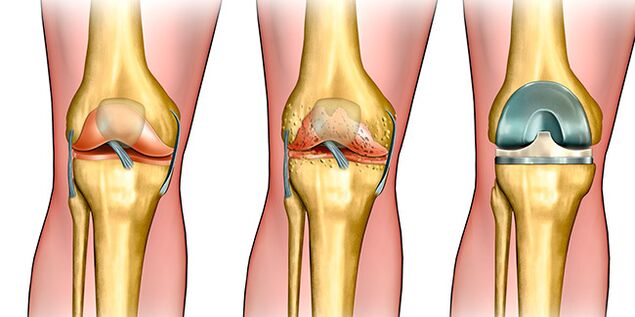
The first degree of osteoarthritis is characterized by mild pain when the leg is in one position for a long time, which goes away after rest.
Diagnosis and basic exposure
Before you start treating knee arthrosis at home, you must be diagnosed by a doctor.It is usually worth seeing an orthopedist.The specialist will carry out an examination, collect anamnesis and refer the patient to an X-ray examination.Some changes can be noticed even in the first stage of the disease, and the second picture will show:
- Partial exposure of bones
- Thinning and destruction of cartilage,
- Reduction of joint space,
- Accumulation of osteophytes.
In rare cases, a CT scan, MRI and blood test are required for the diagnosis.If differentiation is necessary, the patient is referred to a rheumatologist, surgeon or endocrinologist.After making a diagnosis, specialists will choose a complex for arthrosis of the knee joints.It is impossible to completely improve the condition if the disease is already in the second stage.Therapy is aimed at preventing further progression of the pathology and relieving symptoms.
Deforming osteoarthritis of the knee joint requires limited mobility during periods of exacerbation.The attending physician may recommend that the patient wear various devices, such as orthoses.Knee braces for osteoarthritis of the knee joint are designed to help manage pain.Closed types are recommended if the diagnosis is not clearly established.In this case, the joint is supported over a larger area.Open ones are used for occasional pain, while hinged ones are suitable for treating post-traumatic conditions.
Pay attention!Many people are interested in how to choose knee protectors for osteoarthritis of the knee joint.However, only a doctor can choose the right option, and with such a diagnosis, you must be constantly monitored.
Non-drug treatment of pathology includes a variety of procedures and stress.For osteoarthritis of the knee joint, folk recipes can only accompany complex effects.For example, some compresses are applied after physiotherapy and magnetic laser therapy.Alternative treatment for osteoarthritis of the knee joint should also be supervised by a doctor.
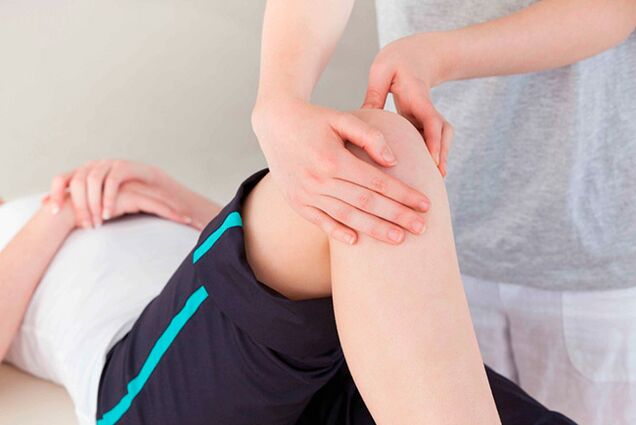
Treatment of the disease includes a complex of orthopedic procedures and drug therapy.It is also possible to use traditional medicine in the initial stages of osteoarthritis.
Physical activity
Deforming arthrosis in the knee joint is often treated with special exercises.It is usually included in a complex of physiotherapy, electrophoresis and other procedures.Complex treatment is common in various clinics.However, such complexes are inaccessible to most people.Free hospitals only offer physiotherapy.Exercise therapy for osteoarthritis of the knee joint helps:
- Reduce pain,
- Establish blood flow
- Strengthen nearby muscles
- Expand the joint space
- Improve the function of the respiratory system
- Correct the condition of the spine.
The main criterion for effectiveness is the systematic implementation of a set of exercises.You can't practice using a video once and hope it will produce results.Reviews of such courses note their benefits only if proper time is allocated to the classes.It is also necessary to understand that at the third stage no physiotherapy will help.
Exercises for arthrosis of the knee joint should be based on a system of alternating intense load and rest.Ten minute periods of tension with breaks are typically used.In total, the training time is half an hour.It is allowed to gradually increase the duration and amplitude of the load.Therapeutic exercises for osteoarthritis of the knee joint usually require three sessions a day, with up to six repetitions of each exercise.
The doctor decides whether it is possible to play sports with this diagnosis.But in most cases pilates, yoga and exercise bikes are not contraindicated.There are specialized courses with therapeutic exercises.
Physiotherapy for osteoarthritis will help strengthen muscles, reduce tension in diseased joints and activate blood circulation in them.
Injections
This disease is very difficult to treat and therefore pills are usually ineffective.In most cases, people try to choose injections for osteoarthritis of the knee joint.Injections can be placed into muscle tissue.In this case, non-steroidal anti-inflammatory drugs are used, as well as analgesics, antispasmodics and vitamin complexes.
Osteoarthritis of the knee joint cannot be treated at home with injections.Many patients are unable to inject themselves and are also at risk of using drugs that are not suitable for them.Fortunately, you can buy non-steroidal anti-inflammatory drugs for internal administration only with a doctor's prescription.
Pay attention!With the exception of the injection form, other types of medicine are dispensed freely at pharmacies.
Some NSAIDs are injected directly into joint tissue.It is believed that in this way it is possible to better stop the inflammation process and achieve an effect already in the first minutes of the medicine.Preparations for injections in the knee joint for osteoarthritis are presented:
- Glucocorticoids,
- hyaluronic acid,
- Chondroprotectors,
- plasma lifting,
- Pain blockers.
The first fight inflammation most effectively.It is better to take the purchased product to a specialist, as it is even more difficult to inject yourself into a joint than into muscle tissue.
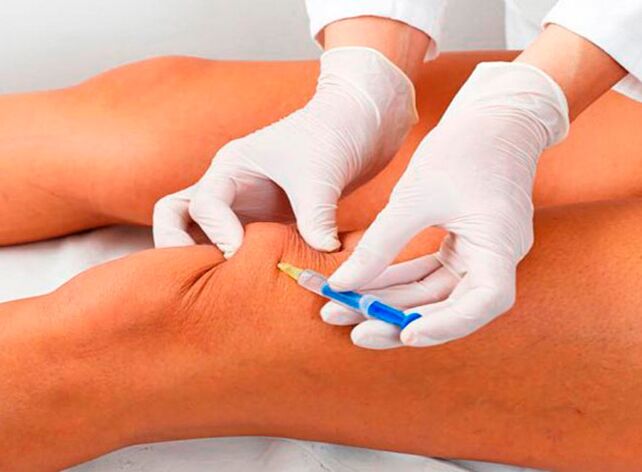
To eliminate pain and relieve inflammation, non-steroidal anti-inflammatory drugs are used, which are most effective as injections into the joint tissue.
External means
Ointments for arthrosis in the knee joint are not effective, and in themselves have virtually no effect.Traditional remedies are presented:
- Use from red, blue or white clay;
- Compresses made from bran, oatmeal, horseradish or potatoes;
- Baths with sea salt or pine needles.
It is possible to treat osteoarthritis of the knee joint at home only in the early stages of the disease.In severe symptoms, only surgery is effective.In the third stage of osteoarthritis of the knee joint, surgery is required.